I've had this book, by Francis Wheen, for some years now, but never felt like reading it. Mumbo-jumbo ranges from the voodoo economics of the 1980s, through postmodernists, catastrophists, neoliberals, the emotional diarrhoea around Princess Diana's death, Chomsky, the third way, right back to modern voodoo economics and radical left reactions to 9/11.
There's some interesting stuff in there. There are some quick background histories to things that you probably already know are wrong, but might not know much about. Wheen lays into Chomsky's record of, if not defending, then at least giving a lot of the benefit of the doubt, to regimes opposed to the US - in particular Cambodia. In a similar way to Nick Cohen, he attacks those who think that because countries like the US so often do bad, they can never do good. There are a few good quotes, which I now can't find.
About a quarter of the way through, though, it begins to drag. I think part of this is because Wheen never ties together his subjects. Wheen explicitly defends enlightenment values like rationality, independent thought, liberalism and humanism, but I don't think this is the whole picture. Does all this 'mumbo jumbo' have the same causes, or are different phenomena independent? Is the strategy to resist or defeat them the same? You might be able to work it out for yourself by studying and thinking about what Wheen says, but honestly, it didn't interest me enough to bother.
One thing that particularly puzzled me were the quotes on the jacket. The book is described by the Spectator as "deliriously funny" and by Jeremy Paxman as "hysterical". Now it certainly did raise some smiles, but no more, suggesting that either Paxman has been hiding a streak of hysteria behind his hard-bitten exterior, or he spends too much time with extremely dull people.
If you want to read a more concise, illuminating and much funnier treatise on a similar subject, read HG Frankfurt's On Bullshit. I've just read someone suggesting that it is itself mostly bullshit, but even if that is the case, it's still thought-provoking bullshit.
Showing posts with label society. Show all posts
Showing posts with label society. Show all posts
Saturday, February 18, 2012


Sunday, April 11, 2010
rags to rags, riches to riches
I've been meaning to write about this for a while, but haven't got round to it until now.
Last month The Guardian reported the finding of an OECD study that the UK has the worst social mobility of the dozen OECD countries for which data was available.
In economics, the basic measure of social mobility is how much someone's income is determined by the income of their parents, after controlling for certain variables. That's certainly not a perfect measure - for example it misses changes in income within people's lives - but it's hard enough to measure as it is. The OECD report also looks at the education, and its relationships with income.
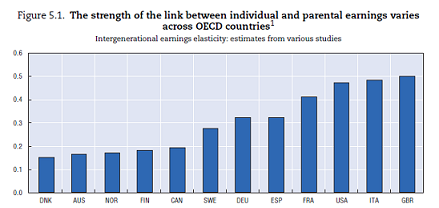
This graph shows how much the income of parents determines the income of their children. The higher the score, the less social mobility there is. In crude terms, the rich stay rich, the poor stay poor. Most people wouldn't need persuading this is a bad thing. The UK is alongside Italy and the US in the difficulty poor children face getting richer, and the ease with which rich children stay rich. (Technically speaking, because of the limited accuracy of the measurements, we probably can't assert any real distinction between them.)
There are a few things I'd like to know more about. First is the influence of intra-generational inequality. The report does talk about this, and I think finds that inequality reduces mobility, but I didn't read it closely enough to understand exactly how, or how they accounted for this. Second, what is the effect of immigration? Migrant status is factored in in some way, but there's no discussion of how it might affect the findings. It may be of note that countries like the US and France have relatively high levels of immigration, Austria and Norway low. Thirdly, how does the size and heterogeneity of the US affect its figures? Eg. do people in poor states stay where they are, rather than making the (comparatively) distant move to a richer state to earn more money?
Those provisos aside, what struck me about this report was the same as other international studies of social mobility I've seen. It's a conventional view that the US is a land where anyone can make it big, that it is full of rags to riches (and riches to rags) stories, and more socially fluid than Europe. The actual evidence suggests otherwise. If you're born into a poor family in the US you're more than twice as likely to stay poor than someone in Denmark, or Canada. If you're born into a rich family, you're more likely to stay rich.
I'd like to have some useful insights for the UK, but unfortunately I don't. The report finds certain educational policies, plus redistributive and income support policies to strongly enhance mobility. If you're interested, have a skim of it yourself.
Last month The Guardian reported the finding of an OECD study that the UK has the worst social mobility of the dozen OECD countries for which data was available.
In economics, the basic measure of social mobility is how much someone's income is determined by the income of their parents, after controlling for certain variables. That's certainly not a perfect measure - for example it misses changes in income within people's lives - but it's hard enough to measure as it is. The OECD report also looks at the education, and its relationships with income.
This graph shows how much the income of parents determines the income of their children. The higher the score, the less social mobility there is. In crude terms, the rich stay rich, the poor stay poor. Most people wouldn't need persuading this is a bad thing. The UK is alongside Italy and the US in the difficulty poor children face getting richer, and the ease with which rich children stay rich. (Technically speaking, because of the limited accuracy of the measurements, we probably can't assert any real distinction between them.)
There are a few things I'd like to know more about. First is the influence of intra-generational inequality. The report does talk about this, and I think finds that inequality reduces mobility, but I didn't read it closely enough to understand exactly how, or how they accounted for this. Second, what is the effect of immigration? Migrant status is factored in in some way, but there's no discussion of how it might affect the findings. It may be of note that countries like the US and France have relatively high levels of immigration, Austria and Norway low. Thirdly, how does the size and heterogeneity of the US affect its figures? Eg. do people in poor states stay where they are, rather than making the (comparatively) distant move to a richer state to earn more money?
Those provisos aside, what struck me about this report was the same as other international studies of social mobility I've seen. It's a conventional view that the US is a land where anyone can make it big, that it is full of rags to riches (and riches to rags) stories, and more socially fluid than Europe. The actual evidence suggests otherwise. If you're born into a poor family in the US you're more than twice as likely to stay poor than someone in Denmark, or Canada. If you're born into a rich family, you're more likely to stay rich.
I'd like to have some useful insights for the UK, but unfortunately I don't. The report finds certain educational policies, plus redistributive and income support policies to strongly enhance mobility. If you're interested, have a skim of it yourself.
Tuesday, May 13, 2008
Why did I not know about this?
From this post on Gin, Television and Social Surplus.
I was recently reminded of some reading I did in college, way back in the last century, by a British historian arguing that the critical technology, for the early phase of the industrial revolution, was gin.
The transformation from rural to urban life was so sudden, and so wrenching, that the only thing society could do to manage was to drink itself into a stupor for a generation. The stories from that era are amazing-- there were gin pushcarts working their way through the streets of London.
Tuesday, May 6, 2008
‘why the fuck are we all so miserable in the first place?’
Lon takes issue with my question "can money buy you happiness?"
The first thing to say to this is that there's no objective measure of happiness anywhere around here. Nothing to say "members of this group are happy", "the people in this country are unhappy". All we can say is that these people are happy than these people or less happy than they used to be. (Incidentally, there are at least two statistical effects tending to push the data here away from the extremes and towards the middle - see comment on the last post.)
As I only hold knowledge about animal behaviour, I have been taught that to keep animals happy, in order for them to breed in captivity and not suffer from depression, species have to be kept as close to their evolved way of life as possible, especially primates.
I've always wondered just how happy animals really are, especially when you take into account their periods of disease, hunger, death of relatives and friends and so-on. Sadly there is no survey data where they trained dogs to bark a number of times to indicate how happy they were.
This sounds like the sort of thing an evolutionary psychologist would say, though. I'd like to see a fight between an evolutionary psychologist and an economist.
Mark takes up the theme:
Though it's not empirical, quantifiable data (something that would be very difficult to glean in this area), I have seen many documentaries & read a lot of articles of traveling reporters & Humanist scientists who have spent time with remote tribes who insist such people, whilst living a subsistence lifestyle, are the happiest people they have ever met. These people spend their lives working for the direct benefit of a small group of people, hunting, gathering, building, growing.
That's a familiar viewpoint, though as with animals I wonder how accurately it reflects the burdens of disease and early death (particularly in childbirth) in these communities.
Naturally, these societies are not reflected in the Gallup, or any other, polls. This does suggest, however, that rural populations might be happier than urban ones - having a somewhere more traditional lifestyle. That's not something that's obviously borne out in the data, though one interesting theory you could propose is that the reason Easterlin found a paradox and this data is because poor countries have urbanised a great deal since the 1970s. Still, I don't think it's an argument that would stand up to scrutiny.
The point is, what should we be aiming for to make people happier? (If we accept that as a reasonable goal.) Some positive points about increasing incomes there is good evidence of a strong relationship between increasing income and happiness and that it's something people, governments, society and suchlike are experienced thinking about. One of the downsides is that that doesn't necessarily mean they're good at doing it.
In other words, it's not a foregone conclusion that effort put into increasing GDP will be more successful than the same amount of effort put into increasing happiness another way. Trying to increase GDP is certainly not the same thing as succeeding... Though that applies to other changes as well. The US experience is salutary. Here's a case where a country has increased its GDP, with the assistance of government policies strongly aimed at this, at the expense of other goals. This success on GDP hasn't made people any happier.
So what should we be doing to make people happier? To start with, none of this is prescriptive at an individual lesson. It's not saying the way to make yourself happy is to go out and try and raise your income. In terms of broader social and political aims, should economic growth (with appropriate environmental caveats) be our primary aim? Or would we be better off using other means?
The question of whether we might benefit from trying tomould our societies more closely to homo sapiens' 'natural state' and/or incorporate more features from tribal societies is one that I'm going to have to leave open.
Interesting as Wolfers and Stevenson's research is, it still leaves these questions wide open for debate. And even the specific argument about happiness is bound to keep running away.
The first thing to say to this is that there's no objective measure of happiness anywhere around here. Nothing to say "members of this group are happy", "the people in this country are unhappy". All we can say is that these people are happy than these people or less happy than they used to be. (Incidentally, there are at least two statistical effects tending to push the data here away from the extremes and towards the middle - see comment on the last post.)
As I only hold knowledge about animal behaviour, I have been taught that to keep animals happy, in order for them to breed in captivity and not suffer from depression, species have to be kept as close to their evolved way of life as possible, especially primates.
I've always wondered just how happy animals really are, especially when you take into account their periods of disease, hunger, death of relatives and friends and so-on. Sadly there is no survey data where they trained dogs to bark a number of times to indicate how happy they were.
This sounds like the sort of thing an evolutionary psychologist would say, though. I'd like to see a fight between an evolutionary psychologist and an economist.
Mark takes up the theme:
Though it's not empirical, quantifiable data (something that would be very difficult to glean in this area), I have seen many documentaries & read a lot of articles of traveling reporters & Humanist scientists who have spent time with remote tribes who insist such people, whilst living a subsistence lifestyle, are the happiest people they have ever met. These people spend their lives working for the direct benefit of a small group of people, hunting, gathering, building, growing.
That's a familiar viewpoint, though as with animals I wonder how accurately it reflects the burdens of disease and early death (particularly in childbirth) in these communities.
Naturally, these societies are not reflected in the Gallup, or any other, polls. This does suggest, however, that rural populations might be happier than urban ones - having a somewhere more traditional lifestyle. That's not something that's obviously borne out in the data, though one interesting theory you could propose is that the reason Easterlin found a paradox and this data is because poor countries have urbanised a great deal since the 1970s. Still, I don't think it's an argument that would stand up to scrutiny.
The point is, what should we be aiming for to make people happier? (If we accept that as a reasonable goal.) Some positive points about increasing incomes there is good evidence of a strong relationship between increasing income and happiness and that it's something people, governments, society and suchlike are experienced thinking about. One of the downsides is that that doesn't necessarily mean they're good at doing it.
In other words, it's not a foregone conclusion that effort put into increasing GDP will be more successful than the same amount of effort put into increasing happiness another way. Trying to increase GDP is certainly not the same thing as succeeding... Though that applies to other changes as well. The US experience is salutary. Here's a case where a country has increased its GDP, with the assistance of government policies strongly aimed at this, at the expense of other goals. This success on GDP hasn't made people any happier.
So what should we be doing to make people happier? To start with, none of this is prescriptive at an individual lesson. It's not saying the way to make yourself happy is to go out and try and raise your income. In terms of broader social and political aims, should economic growth (with appropriate environmental caveats) be our primary aim? Or would we be better off using other means?
The question of whether we might benefit from trying tomould our societies more closely to homo sapiens' 'natural state' and/or incorporate more features from tribal societies is one that I'm going to have to leave open.
Interesting as Wolfers and Stevenson's research is, it still leaves these questions wide open for debate. And even the specific argument about happiness is bound to keep running away.
Subscribe to:
Posts (Atom)


 Posts
Posts

