Now there's at least one obvious problem with this approach to happiness. To quote my psychologist cohort Chelle, "[t]he main problem with self report is that people are big fat liars." A more thorough survey would look at physiological and other objective measures. But of course, happiness and other emotional state are subjective experiences, so self-reporting is not an unreasonable measure. It should also be noted that 1) the Wolfers-Stevenson paper is titled "...Subjective Well-Being..." and 2) any criticisms of self-reporting apply just as much to the classic Easterlin study.
What about the main questions, which ask variations on 'how do you rate your life?' or 'how happy are you with your life?' Maybe we're placing too much weight on that one form of question?
Well one of the interesting things here is that the Gallup surveys include a whole range of other questions related to happiness, from "did you experience sadness yesterday?" to "did you have tasty food yesterday?" The relationship in most cases is pretty weak, but in every case increased income improved people's lives (or so they said). (See here.)
Have a look at depression, for example. I know I would have said that rates of depression are higher in rich countries; there's all this angst about unfulfilling consumerist lifestyles, suburban anomie, lack of social support and so-on. It turns out, though, that if you ask people "have you experienced feelings of depression" that's not what you find.
Lon asks another sensible question, "If money can buy happiness, shouldn't that mean the majority of the world would have committed suicide by now?"
To start with, I haven't found any international rates for depression, but there is data for suicides (see here). On the whole it seems more people kill themselves in rich countries (though China and India are major mid-liers and stats for Africa are almost non-existent). Suicide is a pretty puzzling phenomenon and I don't think it's one that relates to other factors in a clear way. Depression, and other mental illnesses, it's harder to say, but depression is a global burden - I think the WHO rates it something like #4 in its list of problem-causing diseases. We're much more aware of it in the rich world partly because we have resources for diagnosis. And, to give the professionals some credit, that may also be why we report lower rates.
That aside, if you trace the best fit line back, it hits 0 on the x-axis with a happiness score not far below Togo(?) and Benin. That's roughly how happy cavepeople might have been... It doesn't seem horrifyingly unhappy.
Showing posts with label happiness. Show all posts
Showing posts with label happiness. Show all posts
Monday, May 5, 2008


Saturday, May 3, 2008
Happiness is...
positively related to the log of Gross Domestic Product per head.
It's a fundamental notion in economics that expanding output of goods and services - that is, GDP - makes people happier. That is a view that has always been challenged by some individuals and philosophies, but it has always been dominant in economics and in politics, both capitalist and socialist.
In 1974, however, Richard Easterlin studied the empirical evidence from surveys that asked people how happy they were. Easterlin found the following paradox:
1) within countries rich people are happier than poor people.
2) rich countries are not happier than poor countries.
3) countries do not get happier as they get richer.
This is a finding that remains controversial to this day. One of the theories that can be drawn from it is that richer people are happier because they compare themselves to less well off people. Naturally, we compare ourselves more to people in the same country as us, which is why it is income differences within countries that have an effect. The idea that steadily increasing wealth isn't automatically making us happier - indeed it may be making us more unhappy - has become widespread, if not quite mainstream. Examples range from the Kingdom of Bhutan's commitment to "Gross National Happiness" to the concept of Affluenza, developed by psychologist Oliver James, to even the Tory party suggesting it would aim more for happiness than growth. It's certainly a commonplace notion among people I know that rates of depression are higher in rich countries, or at least the UK and US (and possible Japan and Scandinavia), than poor ones.
Recently, the economists Justin Wolfers and Betsey Stevenson have examined more up-to-date evidence on happiness. The approach they use is similar to Easterlin, relying on surveys which basically ask people to rate how happy they are. The results and discussion can be found in a series of posts on the freakonomics blog here and in a proper academic article. They're one of the most interesting things I've read this year.
Wolfers and Stevenson's conclusion is that in fact higher GDP does increase happiness, both within and between countries. Their view is that Easterlin simply didn't have the data available to make any firm conclusions. Since 1974 we have access to much more information, most notable the epic Gallup World Poll.
Plot things on a graph and you get this:
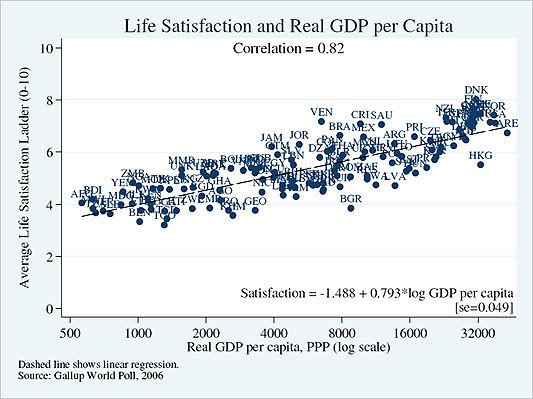
That is clearly a strong correlation between GDP and 'life satisfaction', even without looking at the proper stats (giving an extremely high correlation of 0.82).
One thing that is worth noting before moving on is that the scale for GDP is logarithmic. In other words, an extra $100 increases the happiness of someone on $500 per year more than it does someone on $5000 a year. That's common sense, and something that's accepted by economics, but it's still something that doesn't get emphasised enough.
What the logarithmic scale does show clearly is that a proportional increase in GDP has the same proportionate effect in happiness regardless of how rich you are. It doesn't matter if you are on $500 or $5000, if your income doubles, your happiness will increase by the same proportion (about a third of a unit). If this weren't the case, the best fit line would not be straight.
There is no 'saturation effect' beyond which extra wealth doesn't make people any happier. Or at least, if there is, we haven't reached it yet.
Just to be thorough, Wolfers & Stevenson show that not only are rich countries happier than poor ones, but within countries rich people are happier than poor people (here) but on the whole countries get happier as they get richer (a href="http://freakonomics.blogs.nytimes.com/2008/04/23/the-economics-of-happiness-part-5-will-raising-the-incomes-of-all-raise-the-happiness-of-all/" target="_new">here). The former relationship is universal, but the latter has more problems. It holds for most European countries (but not Belgium), seems to hold (with some caveats) for Japan, but does not apply to the US. On the whole, people in the US have got marginally less happy in the last 30 years. The authors suggest that this may be due to the distribution of income - the rich have got richer, pushing up average incomes, while increasing happiness little (due to the diminishing returns mentioned above). There's more analysis of the US in the full paper, though not of poor grumpy Belgium.
This time-series data also suggests that all this is not simply the result of people comparing their income to others.
Has conventional economics been right all along on this topic? Do we romanticise poverty and the lifestyles of the poor? Figures on suicide (see next post) do suggest rich countries have particular problems, and the US is a salutary lesson not to forget diminishing returns and let the already wealthy take the most benefits. On the whole though, the empirical data suggests they are significantly happier.
(Cliffhanger ending: Or does it..........?)
It's a fundamental notion in economics that expanding output of goods and services - that is, GDP - makes people happier. That is a view that has always been challenged by some individuals and philosophies, but it has always been dominant in economics and in politics, both capitalist and socialist.
In 1974, however, Richard Easterlin studied the empirical evidence from surveys that asked people how happy they were. Easterlin found the following paradox:
1) within countries rich people are happier than poor people.
2) rich countries are not happier than poor countries.
3) countries do not get happier as they get richer.
This is a finding that remains controversial to this day. One of the theories that can be drawn from it is that richer people are happier because they compare themselves to less well off people. Naturally, we compare ourselves more to people in the same country as us, which is why it is income differences within countries that have an effect. The idea that steadily increasing wealth isn't automatically making us happier - indeed it may be making us more unhappy - has become widespread, if not quite mainstream. Examples range from the Kingdom of Bhutan's commitment to "Gross National Happiness" to the concept of Affluenza, developed by psychologist Oliver James, to even the Tory party suggesting it would aim more for happiness than growth. It's certainly a commonplace notion among people I know that rates of depression are higher in rich countries, or at least the UK and US (and possible Japan and Scandinavia), than poor ones.
Recently, the economists Justin Wolfers and Betsey Stevenson have examined more up-to-date evidence on happiness. The approach they use is similar to Easterlin, relying on surveys which basically ask people to rate how happy they are. The results and discussion can be found in a series of posts on the freakonomics blog here and in a proper academic article. They're one of the most interesting things I've read this year.
Wolfers and Stevenson's conclusion is that in fact higher GDP does increase happiness, both within and between countries. Their view is that Easterlin simply didn't have the data available to make any firm conclusions. Since 1974 we have access to much more information, most notable the epic Gallup World Poll.
Plot things on a graph and you get this:
That is clearly a strong correlation between GDP and 'life satisfaction', even without looking at the proper stats (giving an extremely high correlation of 0.82).
One thing that is worth noting before moving on is that the scale for GDP is logarithmic. In other words, an extra $100 increases the happiness of someone on $500 per year more than it does someone on $5000 a year. That's common sense, and something that's accepted by economics, but it's still something that doesn't get emphasised enough.
What the logarithmic scale does show clearly is that a proportional increase in GDP has the same proportionate effect in happiness regardless of how rich you are. It doesn't matter if you are on $500 or $5000, if your income doubles, your happiness will increase by the same proportion (about a third of a unit). If this weren't the case, the best fit line would not be straight.
There is no 'saturation effect' beyond which extra wealth doesn't make people any happier. Or at least, if there is, we haven't reached it yet.
Just to be thorough, Wolfers & Stevenson show that not only are rich countries happier than poor ones, but within countries rich people are happier than poor people (here) but on the whole countries get happier as they get richer (a href="http://freakonomics.blogs.nytimes.com/2008/04/23/the-economics-of-happiness-part-5-will-raising-the-incomes-of-all-raise-the-happiness-of-all/" target="_new">here). The former relationship is universal, but the latter has more problems. It holds for most European countries (but not Belgium), seems to hold (with some caveats) for Japan, but does not apply to the US. On the whole, people in the US have got marginally less happy in the last 30 years. The authors suggest that this may be due to the distribution of income - the rich have got richer, pushing up average incomes, while increasing happiness little (due to the diminishing returns mentioned above). There's more analysis of the US in the full paper, though not of poor grumpy Belgium.
This time-series data also suggests that all this is not simply the result of people comparing their income to others.
Has conventional economics been right all along on this topic? Do we romanticise poverty and the lifestyles of the poor? Figures on suicide (see next post) do suggest rich countries have particular problems, and the US is a salutary lesson not to forget diminishing returns and let the already wealthy take the most benefits. On the whole though, the empirical data suggests they are significantly happier.
(Cliffhanger ending: Or does it..........?)
Subscribe to:
Posts (Atom)


 Posts
Posts

